Topological path planning
Construct complete routing topologies that connect circuit nets.
PCB routing reasoning benchmark
1Pennsylvania State University | 2Independent Researcher | 3Shanghai Jiao Tong University | 4Microsoft Research | 5Emory University | 6Binghamton University
1,681 industrial-grade, schematic-coupled PCB designs for evaluating connectivity, design-rule compliance, electrical functionality, and tool-augmented agentic routing.
Agentic evaluation
Human-engineered reference routing and model-generated trajectories for the Adafruit Bluefruit LE UART Friend under the No Tools setting, shown side by side for comparison of path planning, connectivity, and design-rule compliance.
Paper results
Complete one-shot and agentic routing results from the current manuscript. Unavailable results are preserved as dashes, matching the paper.
PR is the fraction of expected inputs producing a loadable output. NRR is the percentage of required nets that are connected and free of published design-rule violations; PRR is the percentage of required independent DRC-clean pad-to-pad connections. Missing outputs remain in both routability denominators. Higher is better for PR, NRR, and PRR; lower is better for violations, length, and runtime. Rankings use each model's highest NRR score.
| Model | Size | Experiment | Routability | Connectivity | Design Rules | Routing Quality | Efficiency | |||||||||
|---|---|---|---|---|---|---|---|---|---|---|---|---|---|---|---|---|
| NRR (%) ↑ | PRR (%) ↑ |
Open (%) ↓ | PShort (%) ↓ | NShort (%) ↓ |
Total ↓ | Clr. ↓ | Dist. ↓ | Polygon (%) |
TWL ↓ | #Vias | #Layers | PR ↑ | RT ↓ |
|||
Each model is evaluated across No Tools, Visualization, Routing Score, Semantic Input, Prerouting/Remake, and All Tools. PR uses 500 expected inputs. Avg. Steps is the mean number of recorded agent iterations. Higher is better for PR, NRR, and PRR; lower is better for violations, length, and runtime. Rankings use each model's highest NRR score.
| Model | Size | Agent Configuration | Routability | Connectivity | Design Rules | Routing Quality | Efficiency | ||||||||||
|---|---|---|---|---|---|---|---|---|---|---|---|---|---|---|---|---|---|
| NRR (%) ↑ | PRR (%) ↑ |
Open (%) ↓ | PShort (%) ↓ | NShort (%) ↓ |
Total ↓ | Clr. ↓ | Dist. ↓ | Polygon (%) |
TWL ↓ | #Vias | #Layers | PR ↑ | RT ↓ | Avg. Steps |
|||
Open, physical-short, and logical-short percentages count each affected net once. Polygon is not a violation. A dash indicates an unavailable result in the manuscript.
About the benchmark
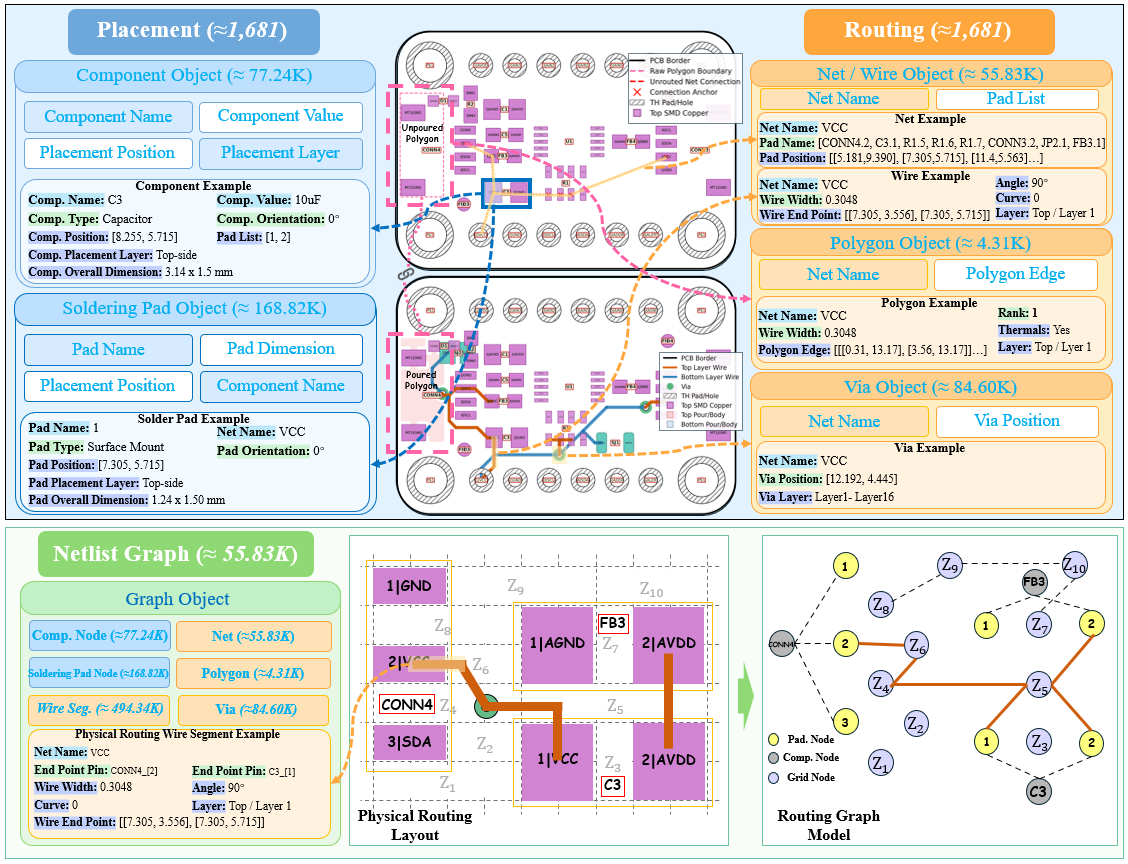
Recent large language models have made progress in constraint-aware navigation and spatial reasoning, but reliable PCB routing additionally demands strict geometric, topological, electrical, and manufacturing constraints. OmniRouting introduces the first large-scale benchmark for this setting, pairing real-world board designs with engineer-verified reference routings and structured evaluation protocols. Current models continue to show weak path planning, poor design-rule adherence, and inconsistent preservation of electrical functionality.
Construct complete routing topologies that connect circuit nets.
Respect clearance, trace-width, via, obstacle, and boundary constraints.
Preserve schematic intent and reference routing behavior.
Iteratively refine routes with visualization, scoring, and semantic feedback.
Citation
T. Lu, K. Lin, Z. Dong, et al., “OmniRouting: A Semantic-Coupled Multimodal Benchmark for Constraint-Aware Spatial Reasoning in PCB Routing,” arXiv preprint arXiv:2608.04434, 2026.
View on arXiv@misc{lu2026omnirouting,
title={OmniRouting: A Semantic-Coupled Multimodal Benchmark for Constraint-Aware Spatial Reasoning in PCB Routing},
author={Lu, Taiting and Lin, Kaiyuan and Dong, Ziwei and Bei, Sisong and Ye, Haolin and Tian, Yuxin and Liu, Runze and Wang, Mingjia and Zeng, Jingying and Pan, Hongxing and Zhang, Kai and Wang, Haoyu and Shi, Guoliang and Ma, Ling and Yang, Yifan and Lu, Jiaying and He, Qi and Chen, Yi-Chao and Chen, Sung-Liang and Jin, Yincheng and Gowda, Mahanth},
year={2026},
eprint={2608.04434},
archivePrefix={arXiv},
primaryClass={cs.CV},
url={https://arxiv.org/abs/2608.04434}
}